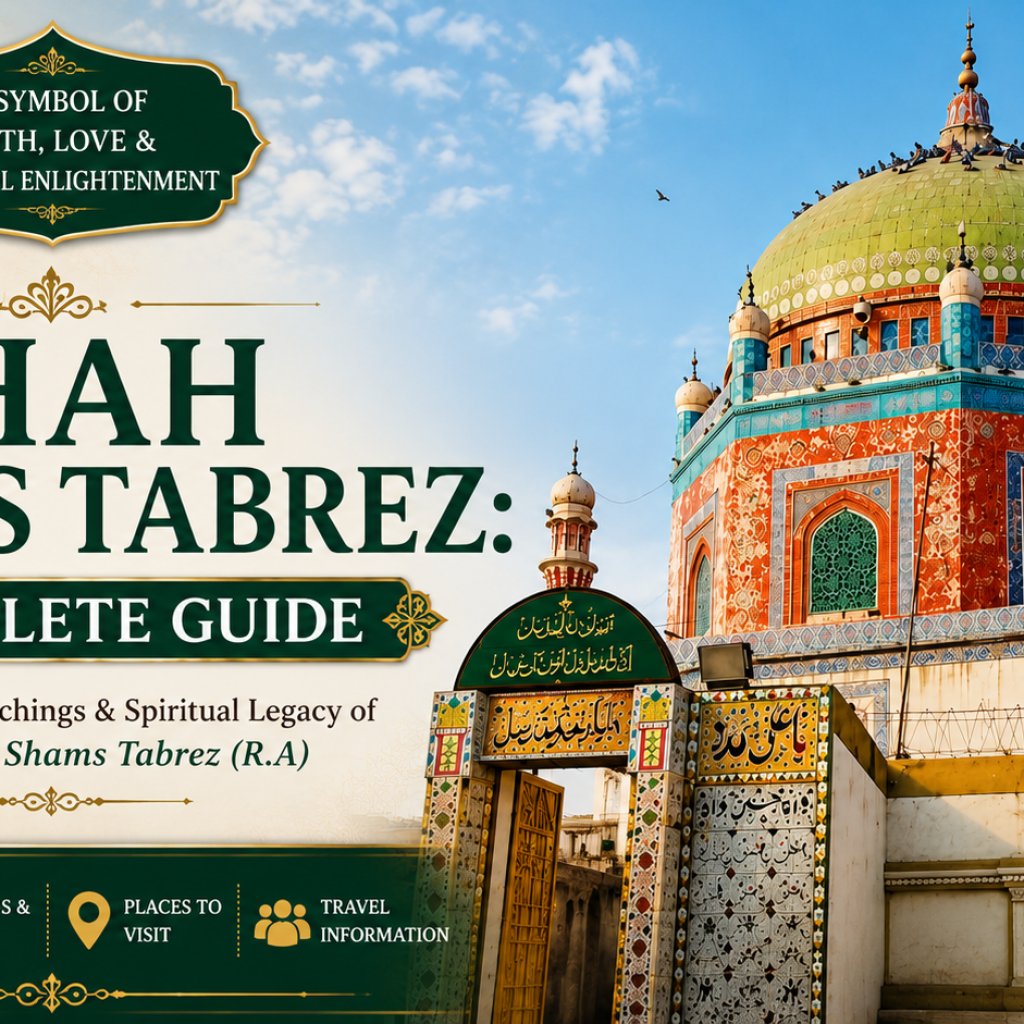
Shah Shams Tabrez: A Complete Guide
One of the most storied shrines of Multan honours a great missionary saint. It honours a great missionary saint who came from Persia many centuries ago. It carries a famous legend of a saint who called the sun down to earth. It gives folk memory a reason for the fierce summer heat of Multan. It draws devotees to its green tiled dome on the old bank of the Ravi. This guide covers the shrine for the curious traveller. It explains the saint the great legend the history the tomb and how to visit.
This guide offers a general overview. Figures, dates and legends vary between sources.
Quick answer: The Shrine of Shah Shams Tabrez is a medieval Sufi mausoleum in Multan, southern Punjab, east of the old fort near the Aam Khas Garden. It honours Pir Shamsuddin Sabzwari an Ismaili missionary saint from Sabzwar in Iran, who settled in Multan around 1200 and died about 1276. His grandson built the tomb around 1330 a square structure with a hemispherical dome and glazed tiles. A famous legend links the saint to the fierce heat of Multan. Winter is the best time to visit.
About the shrine of Shah Shams
A great Sufi mausoleum rises in southern Punjab. It rises east of the old fort of Multan. It rests on the high bank of the old bed of the Ravi. It is one of the most revered shrines in the city.
It honours a great missionary saint. Shah Shams came to Multan from Persia. His teaching drew many followers over the years. His shrine became a centre of devotion.
He is known by many names. Devotees call him Shah Shams Tabrez. Others know him as Shams Sabzwari Multani. His title Shah Shams means the King of the Sun.
A green domed tomb marks the site. A square chamber rises to a dome. Glazed tiles glint across its walls. It rests near the Aam Khas Garden.
Shah Shams the saint
Shah Shams was a great Ismaili saint. He was born around 1165 in Sabzwar in Iran. He descended from the line of Imam Jafar Sadiq. He was raised and schooled in his native land.
He was a great missionary. He carried the Ismaili faith across many lands. He preached in Badakhshan, Kashmir, Sindh and Gujarat. He made Multan the base of his mission.
He settled at last in Multan. He reached the city around the year 1200. He built a religious centre that flourished. He spent his final years in the city.
He left a body of poetry. His ginans are devotional verses of the Ismaili tradition. They address the world of the spirit. He died around 1276 in Multan.
Great legend of the sun
A famous legend surrounds Shah Shams. It explains the fierce heat of Multan. It is one of the best known tales of the city. Devotees tell it to this day.
This story begins with a rebuff. People shunned the saint and denied him help. He held a piece of meat but had no fire. No one would let him cook his food.
He called upon the sun. He asked the sun to draw near to him. He could not rise to it, so it came down to him. Its heat cooked the meat where he stood.
Multan grew hot from that day. A blazing sun had come so close to the earth. Folk memory blames this for the great heat. So the saint earned the name King of the Sun.
History of the shrine of Shah Shams
He died around 1276. He passed his final years in Multan. Devotees mourned the loss of the great missionary. His memory endured in the city.
His grandson built the tomb. Construction was completed around 1330. It rose over the grave of the saint. It became a great centre of pilgrimage.
Its shrine grew in fame. Pilgrims came to honour the King of the Sun. Its legend spread across the country. Devotion has lasted for seven centuries.
A note on the name is useful. Some confuse the saint with Shams Tabrizi. That saint was the companion of the poet Rumi. Scholars regard them as two different figures.
Tomb and the sights
This tomb is square in plan. Its chamber rises around 30 feet high. A hemispherical dome crowns the structure. This form recalls the Multan style.
Glazed tiles adorn the shrine. Bright ornamental tiles clad the walls. Blue and green patterns catch the light. This tilework marks the shrines of Multan.
Its setting is historic. It rests near the Aam Khas Garden. It rises on the old bank of the Ravi. A great fort mound rises to the west.
Other shrines lie close by. Bahauddin Zakariya rests on the fort mound. Shah Rukn e Alam crowns the citadel. Dedicated guides cover these nearby shrines.
Visiting the shrine of Shah Shams
Come in winter. Multan is famously very hot in summer. Winter months from November to February are the finest season. Weather is mild and pleasant then.
Reach it east of the fort. It rises near the Aam Khas Garden. It is a short way from the old fort mound. Roads from the city centre lead there.
Time it with the Urs. This festival falls in June. Pilgrims gather in great numbers then. It is the main event of the shrine.
See it with the other shrines. Bahauddin Zakariya and Shah Rukn e Alam rise nearby. An old fort mound is close at hand. Dedicated guides cover these sights.
Frequently asked questions
Who was Shah Shams Tabrez? Shah Shams Tabrez, more accurately known as Pir Shamsuddin Sabzwari Multani, was an Ismaili missionary saint born around 1165 in Sabzwar in Iran. He is said to descend from the line of Imam Jafar Sadiq. He carried the Ismaili faith across Badakhshan, Kashmir, Sindh and Gujarat before settling in Multan around 1200 where he established a flourishing religious centre. He is remembered as a saint through his devotional poetry, known as ginans as well as through local tradition. He died around 1276 and was buried in Multan where he is also called Shams Sabzwari Multani.
Why is he called the King of the Sun? A title, Shah Shams, means the King of the Sun. It is tied to the most famous legend about the saint. According to the story the people of Multan shunned him and refused to let him cook a piece of meat he had obtained. Unable to rise up to the sun, he called upon it to come down to him. Its heat cooked the meat where he stood. Folk memory holds that the sun came so close that day that it explains the fierce summer heat of Multan ever since.
Is Shah Shams the same as Shams Tabrizi? No although the two are often confused. Shams Tabrizi was the celebrated spiritual companion of the poet Rumi a Sunni figure who died around 1273. Shah Shams Sabzwari of Multan, who died around 1276, was an Ismaili missionary saint of a different background and tradition. Scholars regard them as two distinct figures who happened to live in the same era and share a similar name. This saint of Multan is properly Shamsuddin Sabzwari, sometimes given the additional name Tabrez in local usage.
When was the shrine built? A grandson built the shrine around 1330, roughly half a century after the death of the saint. It rises east of the old Multan fort, on the high bank of the old bed of the Ravi River, near the Aam Khas Garden. It is square in plan, rising around 30 feet in height and crowned by a hemispherical dome. Its exterior is decorated with the ornamental glazed tiles that are typical of the classic architectural style of Multan.
When is the best time to visit the shrine? Winter, from November to February, is the best time to visit the shrine of Shah Shams Tabrez, when the weather in Multan is mild and pleasant. This is fitting for a saint so tied to the heat of the sun. Multan is famously one of the hottest cities in the country in summer. It rises east of the old fort mound, near the Aam Khas Garden. It can easily be combined with the nearby shrines of Bahauddin Zakariya and Shah Rukn e Alam. An annual Urs, held in June, draws especially large crowds.
Shrine of the King of the Sun
This shrine is the shrine of the King of the Sun. It rose over the tomb of a great Ismaili missionary from Persia. It carries the famous legend that explains the heat of Multan. It glows with the green and blue tiles of the old city. It rests on the ancient bank of the Ravi near the fort. Few shrines carry such a vivid legend.
You may come to the shrine for the saint the legend or the tilework. This holy place rewards the visit either way. You can stand before the green domed tomb of the great missionary. You can recall the tale of the sun brought down to earth. You can pass on to the other great shrines of Multan. Come in winter and feel the story of the place. This is the shrine of the King of the Sun.


