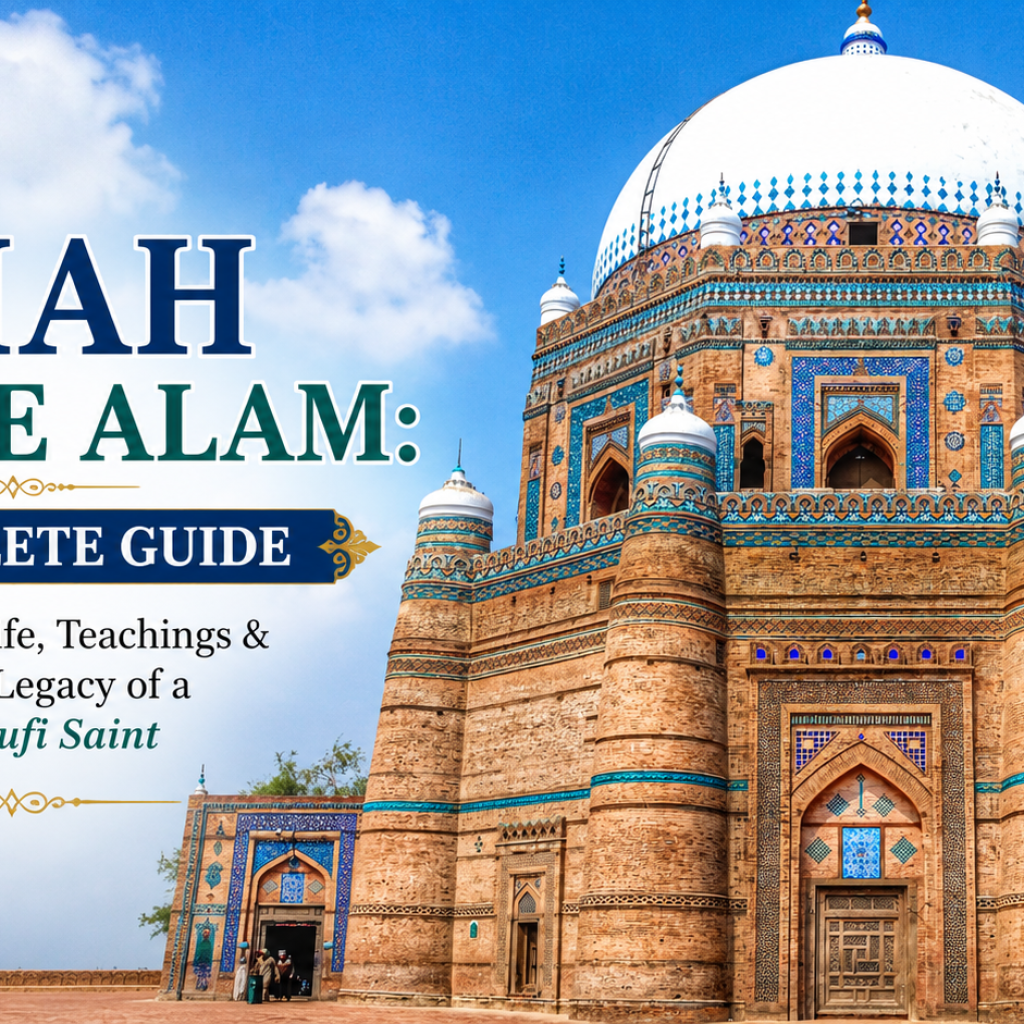
Shah Rukn e Alam: A Complete Guide
One shrine crowns the glory of Multan the Tomb of Shah Rukn e Alam. It rises on the ancient fort mound as one of the great wonders of South Asia. It was built for a king and given to a beloved saint. It is the earliest masterpiece of a whole style of architecture. It draws over a hundred thousand pilgrims to the city of saints each year. This guide covers the shrine for the curious traveller. It explains the saint the history the architecture the tilework and how to visit.
This guide offers a general overview. Figures and dates vary between sources.
Quick answer: The Tomb of Shah Rukn e Alam is a 14th century Sufi mausoleum on the fort mound of Multan in southern Punjab. It honours Sheikh Rukn ud Din Abul Fath, known as Shah Rukn e Alam a Suhrawardi saint and grandson of Bahauddin Zakariya. It was built between 1320 and 1324 by Ghiyas ud din Tughlaq. Its octagonal three tiered form is the earliest example of Tughlaq architecture. Its blue tiled dome is a landmark of the city. Winter is the best time to visit.
About the shrine of Shah Rukn e Alam
A great Sufi mausoleum rises in southern Punjab. It rises on the fort mound of Multan. It occupies one of the highest points in the old city. It is one of the most magnificent shrines in the country.
It crowns the skyline of Multan. Its great dome is visible from far away. Blue tiles glint across its towering walls. It is the emblem of the whole city.
It honours a great saint. Shah Rukn e Alam was a beloved Sufi master. His shrine draws pilgrims from across South Asia. This devotion has lasted for seven centuries.
A soaring tomb marks the site. Three great tiers rise to a dome. Red brick and blue tile clad the walls. It is a masterpiece of its age.
Shah Rukn e Alam the saint
Shah Rukn e Alam was a great Sufi master. His name means the Pillar of the World. He was born in 1251 in Multan. He belonged to the Suhrawardi order of Sufism.
He came from a saintly line. He was the grandson of Bahauddin Zakariya. He became the successor of that great saint. His own dedicated guide covers his grandfather.
He spread the Sufi message widely. He taught love, humility and service to others, drawing many followers to the Sufi path across southern Punjab and beyond. He carried on the work of his forebears.
He died in 1335. He passed away at a great age. Devotees first buried him beside his grandfather. His coffin later moved to the great tomb.
History of the shrine of Shah Rukn e Alam
A Tughlaq king built the tomb. Ghiyas ud din Tughlaq raised it between 1320 and 1324. He was then governor of Depalpur. He built it as his own resting place.
Its purpose then changed. Ghiyas ud din rose to rule the Delhi Sultanate. His son later gave the tomb to the saint's family. It became the resting place of Shah Rukn e Alam.
His body was moved here. Devotees first buried him beside Bahauddin Zakariya. His coffin was later transferred to this grand tomb. Many of his descendants rest here too.
This tomb shaped a whole style. It is the earliest example of Tughlaq architecture. Later monuments in Delhi and Uch drew on its form. Its influence spread across the subcontinent.
Architecture of Shah Rukn e Alam
This tomb is a marvel of Tughlaq design. It rises in three great tiers. An octagon forms each of the lower levels. A dome crowns the whole structure.
A first tier forms a mighty octagon. Its walls run around 41 feet high. Sloping towers buttress each of the eight corners. Thick brick gives the base great strength.
A smaller octagon rises above. It leaves a narrow passage around the lower roof. This second tier lifts the eye upward. It carries the great dome.
A hemispherical dome crowns the tomb. It rises to around 100 feet in all, lifting the eye above the whole of the old city. This soaring form dominates the skyline. Few domes in the country match its grandeur.
Tilework and decoration of shrine of Shah Rukn e Alam
This tomb glows with colour. Glazed tiles cover much of the exterior. Dark blue azure and white fill the patterns. These contrast with the deep red of the brick.
Red brick forms the body. Fine polished bricks make up the walls. Beams of shisham wood bind the structure. These beams have turned black over the centuries.
Its patterns are intricate. Geometric designs and calligraphy adorn the tiles. Floral motifs run across the panels. This tilework recalls the blue pottery of Multan.
Its interior is serene. Quranic verses adorn the inner walls. Light filters through the arched openings. A deep calm fills the sacred chamber.
Visiting the shrine of Shah Rukn e Alam
Come in winter. Multan is famously very hot in summer. Winter months from November to February are the finest season. Weather is mild and pleasant then.
Reach it on the fort mound. It rises within the Qasim Bagh fort area. It is reached by Vehari Road or Fort Road. Its height makes it easy to find.
See it with the other shrines. A shrine of Bahauddin Zakariya rises close by. Its own dedicated guide covers that shrine. Both together crown the old city.
Visit with respect. Pilgrims should dress modestly at the shrine. Evening devotions are especially moving. An annual Urs draws vast crowds.
Frequently asked questions
Who was Shah Rukn e Alam? Shah Rukn e Alam, whose full name was Sheikh Rukn ud Din Abul Fath, was a revered Sufi saint of the Suhrawardi order, born in Multan in 1251. His title means the Pillar of the World. He was the grandson and spiritual successor of the great saint Bahauddin Zakariya. He carried on that work in spreading the Sufi message of love, humility and service. He died in 1335 at a great age. His tomb in Multan remains a major centre of pilgrimage, drawing over a hundred thousand devotees each year.
Who built the tomb of Shah Rukn e Alam? This tomb was built between 1320 and 1324 by Ghiyas ud din Tughlaq then governor of Depalpur. He later became the founder of the Tughlaq dynasty of the Delhi Sultanate. He is said to have built it as his own future resting place. Later, however, his son Muhammad bin Tughlaq gave the tomb to the descendants of Shah Rukn e Alam, so that the saint could be buried there. He was first interred beside his grandfather then moved to the grand tomb around 1330.
Why is the tomb architecturally important? This tomb is considered the earliest example of Tughlaq architecture and one of the most impressive shrines in the subcontinent. Its distinctive octagonal, three tiered form, rising around 100 feet to a great dome, became a model for later monuments in Delhi and Uch Sharif. This design combines a mighty lower octagon buttressed by sloping corner towers a smaller octagon above and a hemispherical dome. Built of red brick bound with shisham beams and clad in blue tilework, it defined a distinctive Multani style.
What does the tomb look like inside and out? An exterior of glazed tiles in dark blue azure and white sets off geometric and floral patterns. They contrast with the deep red of the polished brick, recalling the famous blue pottery of Multan. A frame of shisham beams binds the structure together, now blackened with age. Inside the walls are adorned with Quranic verses and decorative tilework. Light filtering through the arched openings creates a deep calm within the vast domed chamber where the saint and many descendants rest.
When is the best time to visit the shrine? Winter, from November to February, is the best time to visit the tomb of Shah Rukn e Alam, when the weather in Multan is mild and pleasant. Multan is famously one of the hottest cities in the country in summer. It rises on the old fort mound within the Qasim Bagh area, reached by Vehari Road or Fort Road. Its great height makes it visible from far off. It rises close to the shrine of Bahauddin Zakariya, so the two can easily be seen together, especially outside the vast crowds of the annual Urs.
Glory of the city of saints
This tomb is the glory of the city of saints. It rose for a Tughlaq king and passed to a beloved saint. It set the earliest pattern of a great architectural style. It crowns the fort mound with its blue tiled dome. It draws pilgrims in their thousands to the heart of Multan. Few shrines rise so grand above a city.
You may come to the shrine for the saint the architecture or the tilework. This holy place rewards the visit either way. You can gaze up at the towering three tiered tomb. You can admire the blue and azure tiles of Multan. You can pass on to the shrine of Bahauddin Zakariya nearby. Come in winter and behold the glory of the city. This is the crowning tomb of Multan.


