Shah Abdul Latif Bhittai and Bhit Shah: A Complete Guide
Shah Abdul Latif Bhittai is the greatest poet of the Sindhi language. He was a Sufi mystic a scholar and a musician. He gathered the folk tales of Sindh into verse of extraordinary beauty. His Seven Queens became the moral heart of Sindhi culture. His shrine at Bhit Shah draws pilgrims and singers every night. This guide covers the poet and his shrine. It explains his life, his poetry the music and how to visit.
This guide offers a general overview. Dates for the early life of the poet vary slightly between sources.
Quick answer: Shah Abdul Latif Bhittai lived from 1689 to 1752. He was a Sindhi Sufi poet, scholar, mystic and musician. He settled on a sand hill that became the town of Bhit Shah. His collected poetry is the Shah Jo Risalo. It is arranged into chapters called Surs. His Seven Queens are heroines of Sindhi folklore. Mian Ghulam Shah Kalhoro built his shrine. His Urs falls in the month of Safar.
Life of the poet
He was born in 1689. His birthplace lay near Hala in the Hyderabad region. Some sources give the year as 1690. His family held a respected Sayyid lineage from Herat.
His father was a spiritual man. Syed Habib Shah raised him in a household of learning. The young man received a religious education. He absorbed the folk culture around him too.
He chose a simple life. He came from a privileged background. He gave up its comforts and lived plainly for the rest of his days. His walking stick and his coconut husk begging bowl survive at Bhit Shah.
He travelled widely in his youth. He journeyed with wandering ascetics for several years. He reached Hinglaj, Lakhpat and Jaisalmer. He crossed the Thar desert too. These travels shaped his poetry deeply.
He settled at Bhit Shah. He chose a sand hill in the Matiari region. The Sindhi word bhit means a sand mound. The place took its name from him.
He died in 1752. Tradition describes his final days in detail. He asked his disciples to play music. He passed away wrapped in a sheet as the music continued.
Shah Jo Risalo
The Risalo is his great work. The title means the message of Shah. It ranks among the masterpieces of South Asian literature.
The work is arranged into Surs. Each Sur is a chapter tied to a musical mode. Around thirty of them make up the collection. This structure binds the poetry to music.
The themes run deep. His verse explores the unity of God. It expresses love for the Prophet. It calls for religious tolerance. These themes give the work its universal reach.
Scholars have compared him to Rumi. Both wrote of divine love in accessible verse. This comparison is often made in studies of Sufi poetry.
He wrote for ordinary people. His language is simple and direct. Fishermen, herders and washerwomen fill his verse. The desert the river and the sea run through it. This grounding gave his work enormous popular reach.
Seven Queens
Seven heroines carry the Risalo. Shah Latif raised seven women of Sindhi folklore to the status of royalty. Devotees call them the Seven Queens. They are the moral centre of his verse.
The Queens are named in the verse. They are Marvi, Momal, Sassi, Noori, Sohni, Sorath and Lila. Each has her own tale and her own Sur in the collection.
Their virtues are what matter. The poet praised their honesty, loyalty and courage. He held them up as models for all people.
Their stories run across Sindh. Marvi belongs to Umerkot and the Thar. Sassi belongs to Bhambore. Momal belongs to the desert country. The dedicated guides cover each of these places.
The tales are mostly tragic. Lovers are separated by distance, family or fate. The poet used their suffering as a metaphor. The longing of the lover mirrors the longing of the soul for God.
Music and the faqirs
He founded a musical tradition. Shah Latif set his verse to specific modes. He is credited with devising a stringed instrument for it. Musicians call that instrument the tanburo.
The faqirs sing at the shrine. Groups of devotee musicians perform the Risalo every night. This practice has continued for generations.
The singing is unbroken. Performers keep the tradition alive through the year. Visitors can hear the Risalo sung most evenings. This living music is what sets Bhit Shah apart.
Shrine at Bhit Shah
A ruler built the shrine. Mian Ghulam Shah Kalhoro ordered its construction. He was a disciple of the poet. He also founded the city of Hyderabad. The dedicated guide to Hyderabad covers his reign.
Later rulers repaired it. Mir Nasir Khan Talpur carried out extensive work. The shrine grew across the generations.
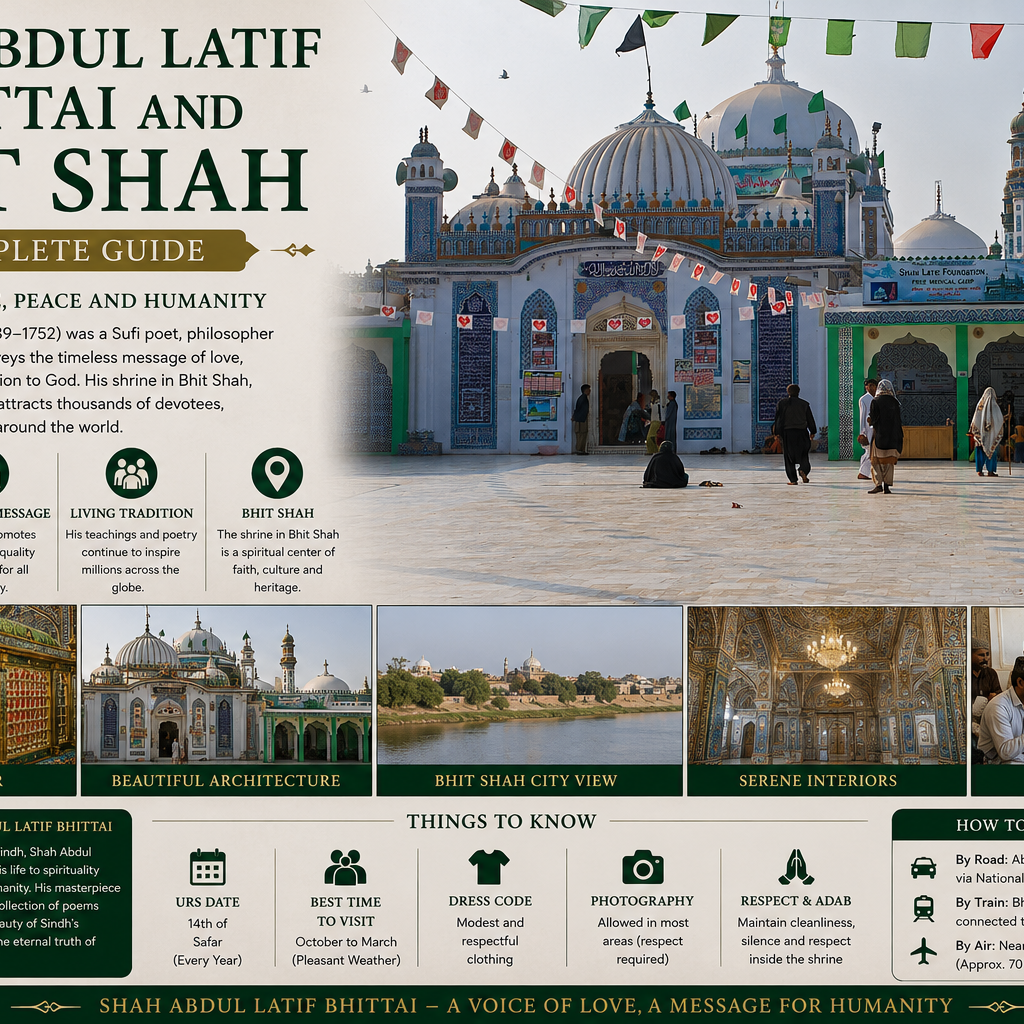
The decoration is beautiful. Blue and white glazed tiles cover the surfaces. This is the kashi work of the region. A dome crowns the tomb chamber. The effect is calm and luminous.
Relics of the poet survive. The complex holds his walking stick and his turban. His coconut husk begging bowl is preserved too. These simple objects moved many visitors.
The Urs draws great crowds. It falls on 14 Safar in the Islamic calendar. Musicians and pilgrims gather for three days. Singers perform the Risalo through the nights. It ranks among the great cultural gatherings of the province.
Visiting Bhit Shah
The town lies in the Matiari district. Bhit Shah is around five kilometres from Hala. Hyderabad lies a short drive to the south. Karachi is roughly three hours away by road.
Come in the evening. The faqirs sing after sunset. The atmosphere deepens as the night goes on. Many visitors find this the finest part of the trip.
Combine it with Hala. The nearby town is famous for its blue pottery and tile work. The dedicated guide to Hala covers its crafts. The two make a natural pairing.
Visit respectfully. The shrine is an active place of worship. Dress modestly and remove your shoes. Follow the guidance of the attendants inside.
Frequently asked questions
Who was Shah Abdul Latif Bhittai? Shah Abdul Latif Bhittai lived from 1689 to 1752. He was a Sindhi Sufi scholar, mystic, poet and musician. Many regard him as the greatest poet of the Sindhi language. He travelled widely in his youth with wandering ascetics. He then settled on a sand hill that became the town of Bhit Shah. His collected poetry is known as the Shah Jo Risalo.
What is the Shah Jo Risalo? The Shah Jo Risalo is the collected poetry of Shah Abdul Latif Bhittai. The title means the message of Shah. Followers gathered his verse into the collection after his death. It is arranged into chapters called Surs. Each Sur is tied to a musical mode. Around thirty make up the work. Its themes include the unity of God, religious tolerance and humanistic values.
Who are the Seven Queens of Bhittai? The Seven Queens are heroines of Sindhi folklore raised to royalty in the Shah Jo Risalo. They are Marvi, Momal, Sassi, Noori, Sohni, Sorath and Lila. The poet praised their honesty, loyalty and courage. He honoured their willingness to risk everything for love. Their tales are mostly tragic. He used their longing as a metaphor for the longing of the soul for God.
Where is the shrine of Shah Abdul Latif Bhittai? The shrine lies at Bhit Shah in the Matiari district of Sindh. Hala is around five kilometres away. Hyderabad lies a short drive to the south. Karachi is roughly three hours away by road. Mian Ghulam Shah Kalhoro built the shrine. Mir Nasir Khan Talpur later repaired it extensively. Blue and white glazed tiles cover its surfaces.
When is the Urs of Shah Abdul Latif Bhittai? The Urs falls on 14 Safar in the Islamic calendar. That date moves through the solar year. The festival runs over three days. Musicians and pilgrims gather from across the province. Faqirs perform the Shah Jo Risalo through the nights. It ranks among the great cultural gatherings of Sindh.
Voice of Sindh
Shah Abdul Latif Bhittai gave Sindh its voice. He took the folk tales of the province and made them literature. He raised seven ordinary women into enduring symbols. He wrote of fishermen, herders and desert travellers. He carried the deepest ideas in the simplest language. His verse belongs to everyone in the province.
You may come to Bhit Shah for the poetry the music or the shrine. The town rewards the visit either way. You can look at the tiled dome above his tomb. You can see the walking stick and bowl he carried. You can sit as the faqirs begin to sing at dusk. Come in the evening and let the Risalo be sung to you. Few places in the country hold such quiet power.