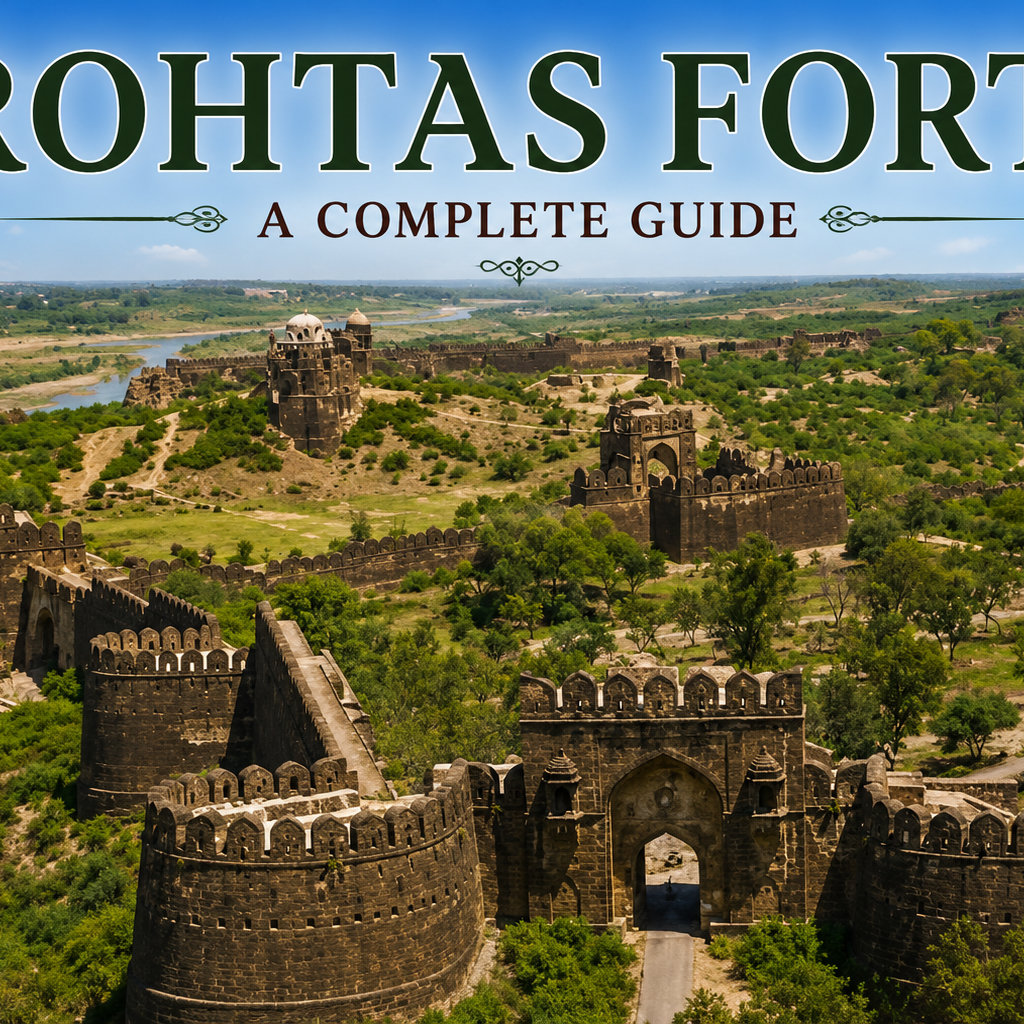
Rohtas Fort: A Complete Guide
Rohtas Fort is one of the mightiest fortresses ever built in South Asia. It rises on a rugged hill near the city of Jhelum in northern Punjab. It was raised by the Afghan king Sher Shah Suri to hold a rebellious frontier. It guards the old Grand Trunk Road between the plains of Punjab and the passes of the north. It has never been taken by storm in nearly five centuries. This guide covers Rohtas Fort for the curious traveller. It explains the history the architecture the great gates the sights and how to visit.
This guide offers a general overview. Figures and dates vary between sources.
Quick answer: Rohtas Fort is a 16th century garrison fortress near Dina and Jhelum in northern Punjab around 16 kilometres north west of Jhelum city. It was built by Sher Shah Suri between 1541 and 1548 to control the Gakhar tribes and block the return of the Mughal emperor Humayun. Its walls run around 4 kilometres, with 68 bastions and 12 monumental gates. It blends Afghan, Persian and South Asian styles. UNESCO named it a World Heritage Site in 1997. Winter is the best time to visit.
About Rohtas Fort
Rohtas Fort is a vast historic fortress in northern Punjab. It is located near the town of Dina, close to Jhelum. It rises on a hill where the Kahan stream meets a rainy nullah. It commands the old road between Punjab and the north west.
A rugged setting defines the fort. Its walls follow the contours of a hilltop. This ground overlooks the Jhelum plains for miles. Defenders held a commanding view of every approach.
Its scale is immense. Walls run for more than 4 kilometres around the site. They rise between 50 and 80 feet in places. This citadel covers around 70 acres of ground.
Its purpose was military. Sher Shah Suri built it to hold a hostile frontier. It could garrison a huge force at one time. This stronghold was meant to intimidate and endure.
History of Rohtas Fort
Sher Shah Suri founded the fort. This Afghan king defeated the Mughal emperor Humayun in 1541. He seized control of the northern subcontinent. He needed a fortress to secure his new frontier.
Two threats drove its construction. Humayun might return through the north western routes. Gakhar tribes of the Potohar remained loyal to the Mughals. This fort was built to face both dangers.
Construction spanned several years. Work ran from 1541 to 1548 under Todar Mal Khatri. Sher Shah Suri died in 1545 before its completion. His successors finished the great fortress.
Its later history was mixed. Humayun retook the north and the fort fell without a fight. Akbar stayed here just one night. Jahangir paused here on his way to Kashmir.
Later rulers used it rarely. Durrani invaders once stationed a garrison here. Sikh rulers gave it away rather than use it. Its military role slowly faded over time.
Architecture of Rohtas Fort
Rohtas is a masterwork of military design. It is an exceptional example of early Muslim military architecture. It blends Afghan, Persian and South Asian styles. This mix gives the fort a unique character.
Its walls are formidable. Massive stone ramparts ring the whole site. Sixty eight bastion towers rise along them. These walls were built to resist any siege.
Terraces aided the defence. Raised platforms let archers fire downward. Bastions allowed deadly crossfire on attackers. This design made the fort nearly impregnable.
A citadel divides the fort. An inner fortress the Ander Kot, rests within the walls. It held the most important buildings. Shah Chandwali Gate connects it to the main fort.
Great gates of Rohtas Fort
Twelve monumental gates pierce the walls. Each served as a controlled point of entry. Several remain in fine condition today. They are among the great glories of the fort.
Sohail Gate is the grandest. It is one of the finest and best preserved gates. It carries sunflower motifs and decorative arches. It houses a small museum today.
Kabuli Gate faces towards Kabul. It has two bastions and an arched entrance. A royal mosque rises beside it. This Shahi Mosque is the most decorated original building.
Shishi Gate is a jewel. It takes its name from its glazed tilework. Blue Kashi tiles glint on its outer arch. These reflective tiles earned it the name Glass Gate.
Other gates served special roles. Langar Khani Gate led to the communal kitchen. Khwas Khani Gate was the original main entrance. Talaqi Gate carried a reputation for bad omens.
Sights within Rohtas Fort
A royal mosque adorns the fort. Shahi Mosque rises near the Kabuli Gate. It has a prayer chamber and a small courtyard. It is the most decorated of the original buildings.
Rani Mahal recalls royal life. This small palace rises near Haveli Man Singh. It once held four rooms in a single storey. Only fragments of it survive today.
Haveli Man Singh shows Hindu style. This mansion reflects a rare blend of traditions. It rises on high ground within the walls. It marks the layered heritage of the fort.
A stepwell serves the garrison. A grand baoli was cut deep into the rock. Its long stairways reach down to the water. This well supplied the fort during any siege.
Visiting Rohtas Fort
Come in winter. Summers here are very hot. Winter months from November to March are the finest season. Weather is cool and pleasant then.
Reach it from Jhelum. Rohtas is located around 16 kilometres north west of Jhelum. A road from Dina leads to the fort. It makes an easy day trip from the Grand Trunk Road.
Explore the great gates. Sohail Gate and its museum are a fine start. Kabuli Gate and the Shahi Mosque reward a visit. Ramparts offer sweeping views of the plains.
Allow a half day. This site is vast and spread over hilly ground. Sturdy shoes help on the rough paths. A local guide brings the history to life.
Frequently asked questions
Who built Rohtas Fort and why? Rohtas Fort was built by the Afghan king Sher Shah Suri, founder of the Sur Empire after he defeated the Mughal emperor Humayun in 1541. He raised it to serve three purposes. It would block any return by Humayun through the north western routes. It would also subdue the Mughal loyal Gakhar tribes of the Potohar and control the strategic Grand Trunk Road. Construction ran from 1541 to 1548 under the supervision of Todar Mal Khatri, his revenue officer.
When was Rohtas Fort built? Rohtas Fort was constructed in the 16th century, with work beginning in 1541, shortly after Sher Shah Suri triumphed over Humayun. Sher Shah Suri died in 1545, before the fort was finished, so his successors completed the work by around 1548. It was named after the fort of Rohtasgarh in Bihar, captured earlier by Sher Shah. Despite its immense scale the fort served the Suri dynasty for only a short time before the Mughals returned to power.
How many gates does Rohtas Fort have? Rohtas Fort has twelve monumental gates, many of which still stand today. Most famous of all is the Sohail Gate, one of the finest and best preserved, used for ceremonies. Others include the Kabuli Gate near the royal mosque and the Shishi Gate with its blue glazed tiles. A Khwas Khani Gate served as the original main entrance. A Langar Khani Gate led to the communal kitchen. Each gate acted as a controlled chokepoint in the defensive design of the fort.
Is Rohtas Fort a UNESCO World Heritage Site? Yes, Rohtas Fort was inscribed as a UNESCO World Heritage Site in 1997. It is recognised as an exceptional example of early Muslim military architecture in Central and South Asia. Its citation notes that the fort was never taken by storm and has survived largely intact to the present day. Its massive walls, extending for more than 4 kilometres and lined with bastions and monumental gateways are considered a masterpiece of 16th century fortification.
When is the best time to visit Rohtas Fort? Winter, from November to March, is the best time to visit Rohtas Fort, when the weather is cool and pleasant for exploring the vast site. Summers here are very hot. Rohtas is located around 16 kilometres north west of Jhelum, near the town of Dina. It makes an easy day trip from the Grand Trunk Road. Visitors should allow a half day to explore the great gates the Shahi Mosque the Rani Mahal and the stepwell. Sturdy shoes help on the hilly ground.
Unconquered fortress of Sher Shah
Rohtas Fort is the great unconquered fortress of the north. It rose from a rugged hill to hold a rebellious frontier. It blocked the return of an emperor and cowed a defiant tribe. It has stood for nearly five centuries without falling to a siege. It blends the styles of Afghanistan, Persia and South Asia in its stone. Few forts speak so clearly of power and foresight.
You may come to Rohtas for the walls the gates or the history. This fortress rewards the visit either way. You can climb the grand Sohail Gate and its museum. You can admire the blue tiles of the Shishi Gate. You can gaze over the plains from the mighty walls. Come in winter and explore the fortress of Sher Shah. Rohtas Fort is the citadel that never fell.


