Khanewal: A Complete Guide
Khanewal is one of the great railway junctions of the country. It grew from a small village into a thriving city when the railways arrived. It rests in one of the most fertile farming areas in the world. It holds the ancient ruins of Tulamba where Alexander the Great once paused. It anchors a district rich in cotton, wheat and the food industry. This guide covers Khanewal for the curious traveller. It explains the history the railway the farming the sights the property scene and how to visit.
This guide offers a general overview. Figures for the population vary between sources.
Quick answer: Khanewal is a city in central Punjab, around an hour from Multan, on the Grand Trunk Road. It grew around one of the busiest railway junctions in the country, established in 1865. It became a district in 1985, with four tehsils: Khanewal, Kabirwala, Mian Channu and Jahanian. It is a great agricultural area, producing cotton, wheat and sugarcane. It holds the ancient ruins of Tulamba and the historic Shrine of Khalid Walid. Winter is the best time to visit.
About Khanewal
Khanewal is a historic railway and farming city in central Punjab. It is located around an hour from ancient Multan. It is the capital of its district in the Multan Division. It blends a railway heritage with a rich farming present.
A fertile plain surrounds the city. Khanewal is located in one of the most fertile areas in the world. Canals water the rich farmland across the district. Cotton, wheat and sugarcane fill the surrounding fields.
Khanewal is a great crossroads. It is one of the most important railway junctions in the country. It also runs along the Grand Trunk Road. This makes it a natural hub for trade and transport.
This district holds four tehsils. These are Khanewal, Kabirwala, Mian Channu and Jahanian. Rural life dominates the district. Farming shapes the life of the whole area.
History of Khanewal
Land here was once barren. Dry scrub covered the area before the canals. A course of the Ravi later shifted nearby. This left fertile soil ideal for farming.
Its name has local roots. A man known as Khan gave his name to the area. He collected revenue here in the 1820s. His fame gave the area the name Khanewala.
Railways made the city. British engineers established the Khanewal junction in 1865. A railway colony was set up in 1904. This junction drove the growth of the town.
Its junction linked the country. It connected Lahore, Multan, Karachi and Faisalabad. It became one of the busiest stations in the network. It played a key role in the development of the area.
Khanewal rose in status. It was a small village before 1911. It became a municipal committee in 1933. It was made a district in 1985.
Railway and farming in Khanewal
Khanewal is a great railway hub. Its junction is among the busiest in the country. Trains from Karachi to Peshawar pass through here. Trains from Quetta to Lahore cross here too.
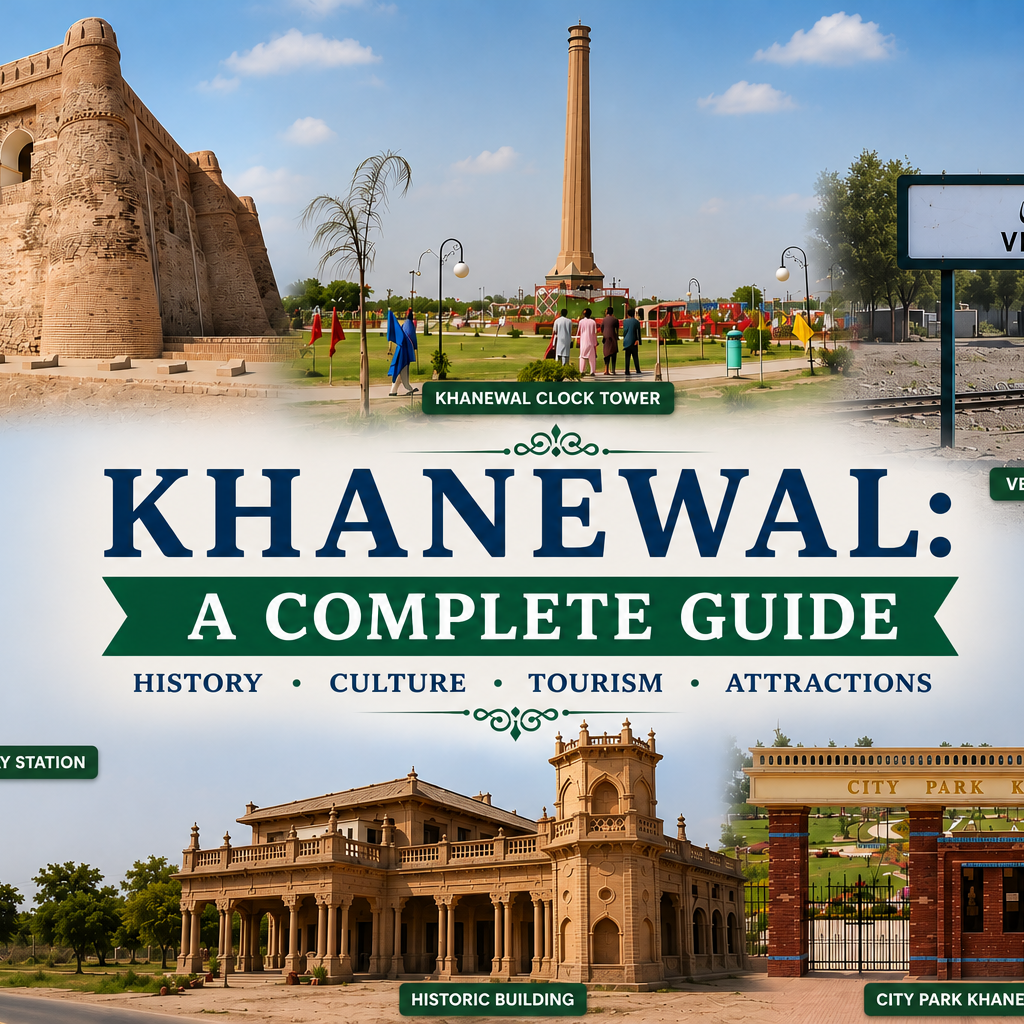
Its station is a landmark. It was established as a strategic point in colonial times. It has multiple platforms and heavy traffic. It remains a major transit hub today.
Farming is the backbone. Fertile plains grow cotton, wheat and sugarcane. Mangoes and guavas ripen in the orchards. This produce feeds the country and its exports.
A strong food industry thrives here. Major food and dairy factories operate in the district. Textile mills and sugar mills add to the base. These industries draw on the local harvest.
Sights in Khanewal
Tulamba is the great ancient site. This ruined city rises near the Ravi in Mian Channu. It is more than 2,500 years old. Its own layered ruins reveal five ages of civilisation.
Tulamba saw great invaders. Alexander the Great paused here on his march. Timur and Sher Shah Suri also took the town. It rested armies on the road to Multan.
Khalid Walid Shrine is a jewel. It rises at Nawan Shehr near Kabirwala. It honours a 12th century warrior saint. It is one of the earliest Muslim funerary monuments in South Asia.
This shrine shows rare artistry. Its fortified walls slope gently inward. Kufic calligraphy adorns its distinctive mihrab. It reflects the Seljuk influences of Central Asia.
Property market in Khanewal
Property here is steady. Farming wealth and the railway support the market. New housing schemes ring the city. Demand rises with the growth of the district.
Location is a great asset. Khanewal is a major railway junction and road hub. A stretch of the Grand Trunk Road runs through it. This connectivity lifts the property market.
Buyers find a varied choice. An old city offers heritage and trade. New schemes offer modern living. A rural fringe offers agricultural land. Each suits a different buyer.
This district keeps developing. Farming and the food industry underpin the economy. Its railway draws trade to the city. This supports the property market.
Visiting Khanewal
Come in winter. Summers here are very hot. Winter months from November to February are the finest season. Weather is mild and pleasant then.
Explore ancient Tulamba. This 2,500 year old ruin is a great highlight. Alexander the Great once paused here. Its layered ruins reward the curious.
Visit Khalid Walid Shrine. This ancient shrine rises near Kabirwala. Its unique architecture is remarkable. It is a rare monument of early Islamic art.
Use it as a base. Ancient Multan is located just an hour away. Kabirwala and Mian Channu reward day trips. Surrounding countryside is rich in heritage.
Frequently asked questions
Why is Khanewal famous? Khanewal is famous as one of the most important railway junctions in the country, a role it has held since the British established the junction in 1865. It grew from a small village into a thriving city around this junction. It is also a great agricultural district in one of the most fertile areas in the world, producing cotton, wheat and sugarcane. This district holds the ancient ruins of Tulamba, over 2,500 years old. It also holds the historic Shrine of Khalid Walid.
What is Tulamba? Tulamba is an ancient ruined city in the Mian Channu tehsil of Khanewal District, standing on the eastern edge of the Ravi River. It is more than 2,500 years old. Archaeological digs have revealed five distinct layers of civilisation. Its ruins include a walled fort with a tower and an ancient protective trench. Tulamba rested the armies of many invaders on their way to Multan, including Alexander the Great, Timur and Sher Shah Suri.
What is the Shrine of Khalid Walid? Khalid Walid Shrine is a Sufi monument at Nawan Shehr near Kabirwala, dating to the late 12th or early 13th century. It honours a warrior saint and is considered one of the earliest Muslim funerary monuments in South Asia. Its architecture features a fortified rectangular structure with inward sloping walls, semicircular bastions and a distinctive mihrab adorned with Kufic calligraphy. These features reflect the Seljuk influences of Central Asia and make it a rare artistic treasure.
How did the railway shape Khanewal? Khanewal owes its existence largely to the railway. British engineers established the Khanewal junction in 1865 and set up a railway colony in 1904, transforming a small village into an important city. This junction linked Lahore, Multan, Karachi and Faisalabad. It became one of the busiest stations in the network. This role determined the economic character of the city as a hub for the collection and transport of agricultural produce, a function it still serves today.
When is the best time to visit Khanewal? Winter, from November to February, is the best time to visit Khanewal, when the weather is mild and pleasant. Summers here are very hot. Winter suits a visit to the ancient ruins of Tulamba and the Shrine of Khalid Walid near Kabirwala. Surrounding countryside also rewards exploration. Khanewal also makes an excellent base for exploring the area, with ancient Multan just an hour away and the smaller towns of Kabirwala and Mian Channu nearby.
Junction city of the fertile plains
Khanewal is the great junction city of the fertile plains. It grew from a village into a city on the strength of its railway. It gathers the trains of the country at its busy junction. It ripens the cotton and wheat of one of the richest farming areas. It guards the ancient ruins of Tulamba on the old road to Multan. Few cities owe so much to the coming of the railway.
You may come to Khanewal for the railway the ruins or the farms. This city rewards the visit either way. You can explore the ancient layered ruins of Tulamba. You can admire the early Islamic art of the Shrine of Khalid Walid. You can use the city as a base for ancient Multan. Come in winter and explore the junction city. Khanewal is the crossroads of the plains.