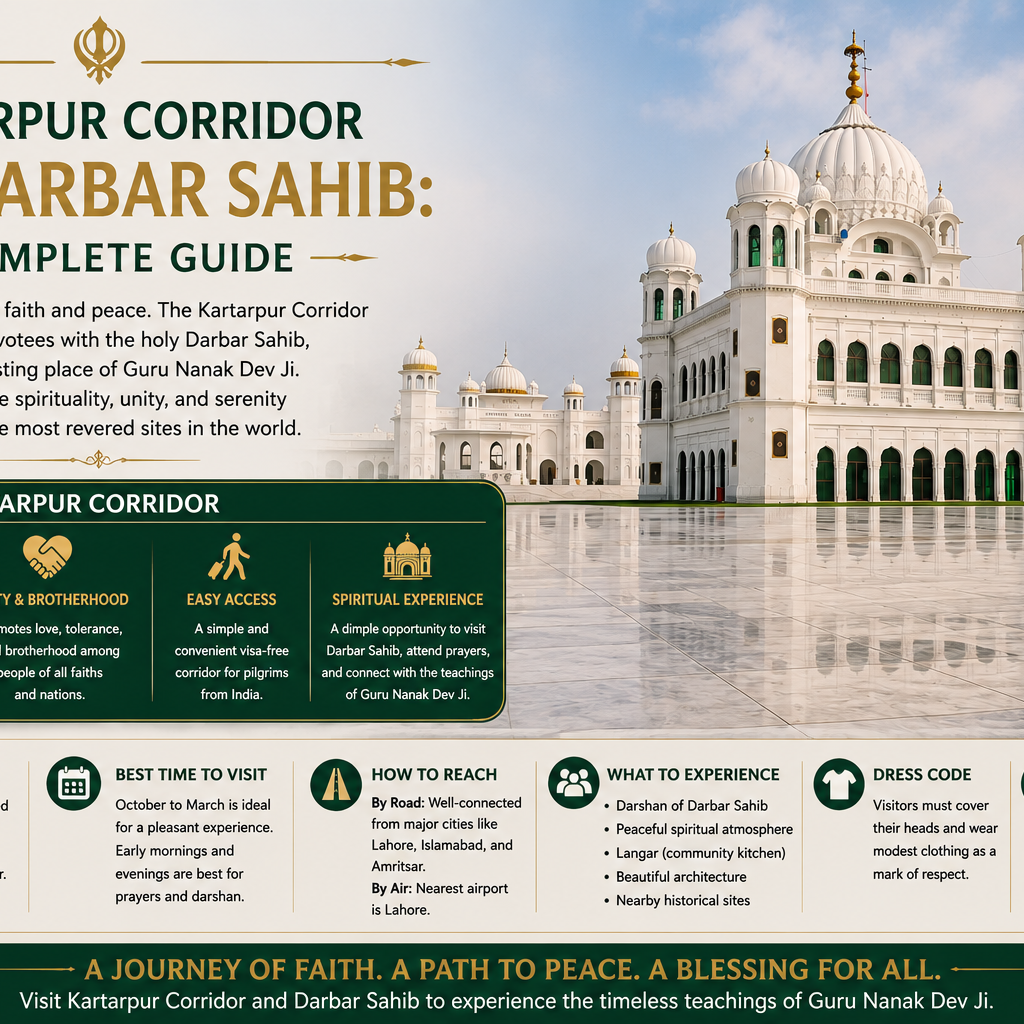
Kartarpur Corridor and Darbar Sahib: A Complete Guide
Gurdwara Darbar Sahib Kartarpur is the second holiest shrine in the Sikh world. It rises on the west bank of the Ravi where Guru Nanak spent his final years. It marks the place where the founder of Sikhism farmed, taught and served the first langar. It draws pilgrims through a famous visa free corridor from across the border. It serves as a rare bridge of peace between two neighbouring nations. This guide covers the shrine and the corridor for the curious traveller. It explains the history, Guru Nanak at Kartarpur the shrine the corridor and how to visit.
This guide offers a general overview. Figures, dates and arrangements vary between sources.
Quick answer: Gurdwara Darbar Sahib Kartarpur is a Sikh shrine at Kartarpur in the Narowal district of Punjab, on the west bank of the Ravi River. It marks the place where Guru Nanak the founder of Sikhism, settled and spent the last 18 years of his life until his death in 1539. It is the second holiest site in Sikhism after Nankana Sahib. A visa free corridor, opened in 2019 allows pilgrimage from across the Indian border. Winter is the best time to visit.
About the Darbar Sahib Kartarpur
Gurdwara Darbar Sahib Kartarpur is a great Sikh shrine in central Punjab. It rises at Kartarpur in the Narowal district. It rests on the west bank of the Ravi River. It is one of the holiest sites in Sikhism.
It marks the final home of Guru Nanak. He spent his last years in this place. His resting place made it a great shrine. Pilgrims revere it across the world.
It is the second holiest Sikh site. Only Nankana Sahib ranks above it in significance. It joins the great shrines of the faith. This gives it deep spiritual weight.
A grand complex marks the site. A white shrine rises amid green fields. A vast courtyard surrounds the building. This ranks among the largest gurdwaras in the world.
Guru Nanak at Kartarpur
Guru Nanak founded the town of Kartarpur. He established it by the Ravi around 1504. He ploughed the fields and farmed the land. He built a settlement for his followers.
He gathered the first Sikh community. He assembled his followers around him here. He set up the first langar the free kitchen. This community meal became central to the faith.
He returned here after his travels. He had journeyed far on his missionary udasis. He reached Mecca, Baghdad, Kashmir and beyond. He settled at Kartarpur for his final years.
He spent his last eighteen years here. He taught, farmed and served the community. He died at Kartarpur in 1539. His shrine rose on the site of his passing.
History of the Darbar Sahib Kartarpur
A shrine rose over the resting place. Devotees marked the site of the passing of the Guru. Ravi waters long threatened the sacred ground. Floods shaped the early history of the shrine.
A great patron built the main shrine. A Maharaja of Patiala funded it in 1925. He raised it as a memorial to the Guru. It honoured the assembly of the first Sikh community.
This shrine was renewed over time. Repairs came in 1995 and again in 2004. A great expansion followed in later years. This work created the grand modern complex.
It was long hard to reach. Indian pilgrims once viewed it from afar. They gazed across the border through binoculars. A raised platform let them glimpse the shrine.
Kartarpur Corridor
A Kartarpur Corridor gives a visa free crossing. It links the shrine to Dera Baba Nanak in India. It runs around four kilometres to the border. It allows pilgrims to visit without a visa.
It opened in a historic year. Foundation stones were laid in November 2018. A grand opening followed in November 2019. This marked the 550th birth anniversary of the Guru.
It carries thousands of pilgrims. Up to 5,000 pilgrims may cross each day. They come from dawn to dusk without a visa. A passport and a small charge are required.
It is called a corridor of peace. Many hail it as a bridge between two nations. It has opened access to a long cherished shrine. This agreement now runs until 2029.
Darbar Sahib Kartarpur Complex
This complex is vast and modern. It spreads over around 42 acres of ground. A white shrine rises at its heart. Green fields and courtyards surround it.
Its main shrine is serene. A domed building marks the resting place. Prayer halls open onto the courtyard. Pilgrims gather here from many lands.
It serves the pilgrims well. A library and museum tell the story of the Guru. Dormitories and lockers aid the visitors. A langar feeds all who come.
An old well recalls the Guru. A red brick well rises within the grounds. It is said to date back many years. It links the site to the farming days of the Guru.
Visiting the Darbar Sahib Kartarpur
Come in winter. These plains are hot in summer. Winter months from November to February are the finest season. Weather is mild and pleasant then.
Reach it in Narowal. It rises at Kartarpur in the Narowal district. It is around 120 kilometres from Lahore. Roads link it to the great city.
Note the corridor rules. Indian pilgrims cross the corridor without a visa. They must carry a passport and pay a service charge. Overnight stays are not allowed through the corridor.
Visit with respect. Pilgrims should cover the head at the shrine. Shoes come off before entering. A free langar welcomes all who come.
Frequently asked questions
Why is Kartarpur important to Sikhs? Gurdwara Darbar Sahib Kartarpur is the second holiest site in Sikhism after Gurdwara Janam Asthan in Nankana Sahib. It marks the place where Guru Nanak the founder of Sikhism, settled after his long missionary travels. He spent the final 18 years of his life here, until his death in 1539. Here he founded the town of Kartarpur, farmed the land, gathered the first Sikh community and established the first langar the free community kitchen. It rises on the site of his passing, making it deeply sacred to Sikhs everywhere.
What is the Kartarpur Corridor? A visa free border crossing the Kartarpur Corridor connects Gurdwara Darbar Sahib Kartarpur in Pakistan with Gurdwara Dera Baba Nanak in India, running around four kilometres to the border. It was inaugurated in November 2019, marking the 550th birth anniversary of Guru Nanak. It allows Sikh pilgrims from India to visit the shrine without a visa. Under the agreement, up to 5,000 pilgrims may cross each day, from dawn to dusk, carrying a passport and paying a service charge. This agreement has been extended to run until 2029.
Who built the shrine at Kartarpur? A main shrine was built here in 1925, funded by the Maharaja of Patiala. It served as a memorial to Guru Nanak and the assembly of the first Sikh community. It was later repaired in 1995 and restored in 2004. In the years before the opening of the corridor, it was expanded into a full complex of around 42 acres, with a courtyard, library, museum, lockers and dormitories. An old red brick well within the grounds is said to date back to the time of Guru Nanak himself.
How can pilgrims visit Kartarpur? Indian Sikh pilgrims can visit Kartarpur through the visa free corridor, registering in advance and crossing from Dera Baba Nanak with a passport and a service charge, from dawn to dusk. Overnight stays are not permitted through the corridor. Pilgrims and visitors from within Pakistan can reach the shrine by road, with Kartarpur lying around 120 kilometres from Lahore in the Narowal district. All visitors should cover the head and remove their shoes before entering. All may share in the langar offered at the shrine.
When is the best time to visit Kartarpur? Winter, from November to February, is the best time to visit Kartarpur, when the weather is mild and pleasant avoiding the intense heat of the plains in summer. This season also includes the birth anniversary of Guru Nanak in November a time of special significance when large numbers of pilgrims gather. It rises at Kartarpur in the Narowal district around 120 kilometres from Lahore. A visit combines well with the other great Sikh sites of the country, such as Nankana Sahib and Panja Sahib.
Final home of Guru Nanak
Gurdwara Darbar Sahib Kartarpur is the final home of Guru Nanak. It rose on the bank of the Ravi where he spent his last years. It marks the place where he farmed, taught and served the first langar. It ranks as the second holiest shrine of the Sikh faith. It welcomes pilgrims through a famous corridor of peace. Few shrines carry such devotion across a border.
You may come to the shrine for the Guru the history or the corridor. This holy place rewards the visit either way. You can bow before the shrine built where the Guru passed away. You can walk the vast courtyard of one of the largest gurdwaras. You can share in the langar and the warmth of the place. Come in winter and feel the devotion of the shrine. This is the final home of Guru Nanak.


