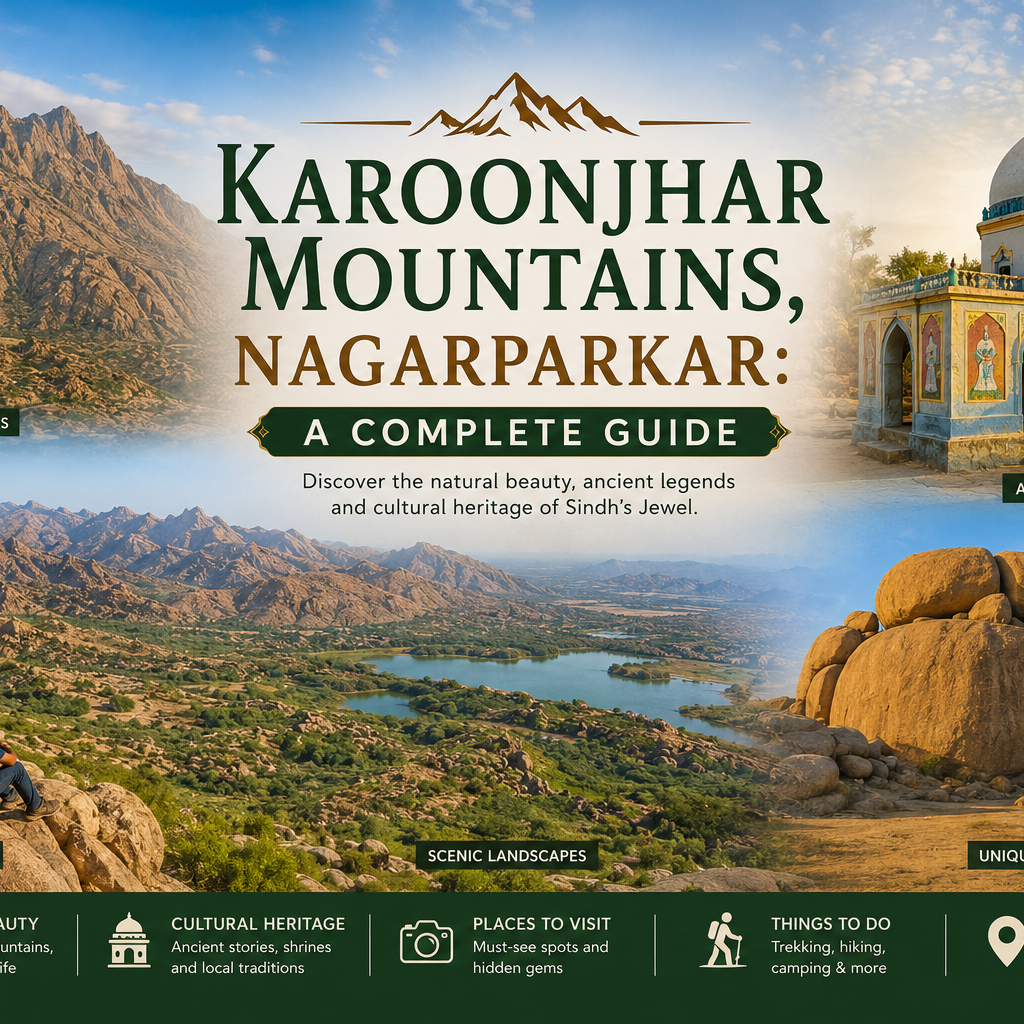
The Karoonjhar Mountains, Nagarparkar: A Complete Guide
Karoonjhar Mountains are one of the great hidden treasures of Sindh. They rise from the desert at the edge of the Rann of Kutch. Their pink granite is among the oldest rock on earth. Ancient Jain temples stand on their slopes. Peacocks call from the rocks and the streams run green after the rains. This guide covers Karoonjhar Mountains for the curious traveller. It explains the geology the history the sights and how to visit.
This guide offers a general overview. Estimates of the age of the rock vary widely between sources.
Quick answer: Karoonjhar Mountains lie at Nagarparkar in the Tharparkar district of Sindh. They rise at the southern edge of the desert beside the Rann of Kutch. The range runs around nineteen kilometres long. It reaches about 305 metres in height. It is made of ancient granite, probably an extension of the Aravalli range in India. The slopes hold Jain temples the Bhodesar Mosque and Marvi's Well. Winter and the season after the monsoon are best.
About Karoonjhar Mountains
The range lies at the edge of the desert. It rises at Nagarparkar in the Tharparkar district. The Rann of Kutch lies to the south. The border with India runs close by.
The mountains are low but striking. The range runs around nineteen kilometres in length. It reaches about 305 metres in height. It is among the lowest ranges in the country. Its granite still commands the flat desert around it.
The name comes from the Sindhi. Karoonjhar joins two words. Karo means black. Jhar refers to dots or specks. The name describes the look of the rock.
The range is little known. Few travellers reach this remote corner. It remains one of the underappreciated sights of the province.
Ancient granite in Karoonjhar Mountains
The rock is extraordinarily old. The mountains are made mainly of granite. They are probably an extension of the Aravalli range in India. That range is among the oldest rock systems on earth.
The age estimates vary widely. Some sources place the rock at around 2.5 billion years. Others suggest an even greater age. All agree it dates to the earliest periods of the planet.
The granite gives the range its colour. The rock takes on pink and grey tones. It glows in the light of dawn and dusk. This colour is part of the appeal of the mountains.
The range holds valuable minerals. Granite and china clay lie within it. Medicinal plants grow on the slopes. This gives the mountains real economic value to local people.
Water and the streams in Karoonjhar Mountains
The mountains gather the monsoon rain. Water pours off the granite in the wet season. It flows out through many streams. More than twenty channels carry it away.
The streams run towards the Rann. Named channels include the Bhatiani and the Gordaro. They flow only in the rainy season. That season usually runs from July to September.
Pools form on the heights. Rainwater collects in hollows on the rock. These pools appear after the monsoon. They are a striking sight on the bare granite.
A dam serves the area. Karoonjhar dam supplies water to Nagarparkar. It captures some of the runoff from the range. This water is a lifeline in the dry desert.
Jain heritage
The area was once a Jain centre. The region held a Jain trading community long ago. They grew wealthy on commerce. They built temples across the area.
An earthquake changed everything. A quake struck the old port of Parinagar. It altered the geography of the area. The Jain community then moved to Kutch and Bhuj in India.
They left their temples behind. The Jains built temples on and around Karoonjhar. Several stood at Nagarparkar and Parinagar. Only a few survive today.
The Gori Temple is the finest. This 16th century Jain temple is the best known. The provincial government has restored it. The dedicated guide to Mithi and Tharparkar covers the wider heritage.
Other sights near in Karoonjhar Mountains
The Bhodesar Mosque blends styles. This white marble mosque lies near the range. A Gujarati sultan built it in the early 16th century. Its design shows the influence of the nearby Jain temples.
Marvi's Well recalls a legend. Locals know it as Marvi Jo Kunh. Tradition ties it to the folk heroine Marvi. The dedicated guide to Umerkot covers her legend.
Sardharo is a picnic spot. The provincial tourism body developed it in the range. A pedestrian bridge links two of the cliffs. It offers a fine view over the mountains.
Historic sites dot the slopes. Bhodesar Talao is an old tank. Alakh Wari is a hidden well. Gao Mukhi is another site of interest. Each rewards the curious traveller.
Wildlife in Karoonjhar Mountains
Peacocks live in the mountains. Wild peafowl roam the slopes and streams. Their calls carry across the granite. They are a signature of the whole Tharparkar region.
The range supports desert wildlife. Foxes and small mammals live among the rocks. Reptiles bask on the warm granite. Birds nest in the crevices and the scrub.
The monsoon brings a green flush. Plants spring up after the rains. The bare rock softens with growth. This greening is the finest time to see the range.
Visiting Karoonjhar Mountains
The range lies at Nagarparkar. Mithi is around 130 kilometres away. Karachi and Hyderabad both connect by road. The journey is long but rewarding.
The border shapes access. The range lies close to the frontier with India. Rangers guard the whole area. Follow their guidance and carry your documents.
Come after the monsoon. Autumn brings the green desert and the flowing streams. Winter brings comfortable weather. These seasons are far better than the summer heat.
Take care in the rain. Avoid the Sardharo picnic spot during heavy rain. The streams can rise quickly. A local guide helps a great deal.
Combine it with Nagarparkar. The Jain temples and the Bhodesar Mosque lie close by. The town itself rewards a visit. Each has its own dedicated coverage.
Frequently asked questions
Where are Karoonjhar Mountains? Karoonjhar Mountains lie at Nagarparkar in the Tharparkar district of Sindh. They rise at the south eastern edge of the desert, beside the Rann of Kutch. The border with India runs close by, so Rangers guard the area. Mithi is around 130 kilometres away. Karachi and Hyderabad both connect by road, though the journey is long.
How old are Karoonjhar Mountains? Karoonjhar Mountains are made of ancient granite. They are probably an extension of the Aravalli range in India among the oldest rock systems on earth. Estimates of the age vary widely between sources. Some place the rock at around 2.5 billion years. Others suggest an even greater age. All agree it dates to the earliest periods of the planet.
What can you see at Karoonjhar Mountains? The range holds a rich mix of nature and heritage. Ancient Jain temples stand on and around the mountains the finest being the restored 16th century Gori Temple. The white marble Bhodesar Mosque lies nearby. Marvi's Well recalls a local legend. The Sardharo picnic spot offers fine views. Peacocks roam the slopes. The streams run green after the monsoon.
Why are Karoonjhar Mountains important? Karoonjhar Mountains are important for several reasons. Their granite is among the oldest rock on earth. They hold valuable minerals and medicinal plants. They gather the monsoon rain and feed more than twenty streams towards the Rann of Kutch. They carry deep Jain heritage in their temples. They are also a haven for peacocks and desert wildlife in a remote corner of the province.
When is the best time to visit Karoonjhar Mountains? The best time falls after the monsoon and through the winter. Autumn brings the green desert and the flowing streams. Winter brings comfortable days for exploring the range. Summer temperatures in the desert can be extreme. Avoid the Sardharo picnic spot during heavy rain as the streams can rise quickly. Travel with a local guide and carry your documents for the border area.
Oldest hills of Sindh
Karoonjhar Mountains are a treasure hidden in the far corner of Sindh. Their granite is older than almost any rock you could stand on. Their slopes hold temples that a vanished community left behind. Their streams run green when the monsoon comes. Their rocks echo with the calls of peacocks. Few places in the province carry such quiet wonder.
You may come to Karoonjhar for the geology the Jain temples or the wildlife. The mountains reward the long journey either way. You can walk among rock that formed at the dawn of the earth. You can visit the restored Gori Temple and the Bhodesar Mosque. You can watch the streams flow after the rains. Come after the monsoon and travel with a local guide. The oldest hills of Sindh are worth every mile of the road.