Bhambore: The Ancient Port of Sindh
Bhambore is one of the most remarkable archaeological sites in Sindh. It holds the remains of a walled port city. That city traded for more than a thousand years. Three civilisations left their mark on the same ground. The site holds one of the earliest mosques in the region. Folklore ties it to the beloved romance of Sassui and Punhun. This guide covers Bhambore for the curious traveller. It explains the history the ruins the museum and how to visit.
This guide offers a general overview to help you plan a visit.
Quick answer: Bhambore is an ancient walled port city in the Thatta district of Sindh. It lies about sixty five kilometres east of Karachi on the N 5 highway. The site was occupied from the 1st century BCE to the 13th century CE. It holds Scytho Parthian, Hindu Buddhist and early Islamic layers. Its mosque carries an inscription dated 727 CE. Many scholars identify the site with the old port of Debal. Folklore links it to the Sassui and Punhun romance.
About Bhambore
Bhambore is an ancient port city. The site holds the remains of a walled city on the north bank of Gharo Creek. It served as a port for many centuries. This coastal position shaped the whole history of the city.
The site spans more than a thousand years. Bhambore was occupied from the 1st century BCE to the 13th century CE. This long occupation makes it enormously valuable to archaeologists.
The name carries several spellings. Sources write it as Bhambore, Banbhore or Bhanbhore. All refer to the same place.
Three civilisations on one site
The site holds three distinct periods. Archaeologists have identified Scytho Parthian, Hindu Buddhist and early Islamic layers. Each left its own remains on the same ground. This layering is the great fascination of Bhambore.
The Scytho Parthian period came first. It ran from around the 1st century BCE to the 2nd century CE. The city traded across the Indian Ocean in this era. Its position at the mouth of the Indus linked it to a wide trading world.
The Hindu Buddhist period followed. It ran from around the 2nd to the 8th century CE. Excavators uncovered the remains of a Shiva temple from this era. Other stone buildings survive from the same period. These remains reveal the faiths that shaped the city.
The early Islamic period closed the story. It ran from the 8th to the 13th century CE. The city reached its final form in these centuries. Its mosque dates from this era.
Debal and the conquest
Many scholars identify Bhambore with Debal. Debal was the port that the Arab general Muhammad bin Qasim took in 711 or 712 CE. He defeated the ruler Raja Dahir there. This identification is widely held, though not universally accepted.
The identification remains debated. Excavations in the twentieth century supported the case for Debal. Other scholars have proposed different locations for the old port. Some have linked the site to an even earlier port named in classical sources. The question remains open.
The conquest opened a new era. The campaign brought Sindh under Umayyad rule. Historians treat the event as a turning point in South Asian history.
Mosque and the ruins in Bhambore
The mosque is one of the earliest in the region. Excavators discovered it in 1960. An inscription dates it to 727 CE. That is around fifteen years after the conquest of Sindh. This makes it among the best preserved early mosques in South Asia.
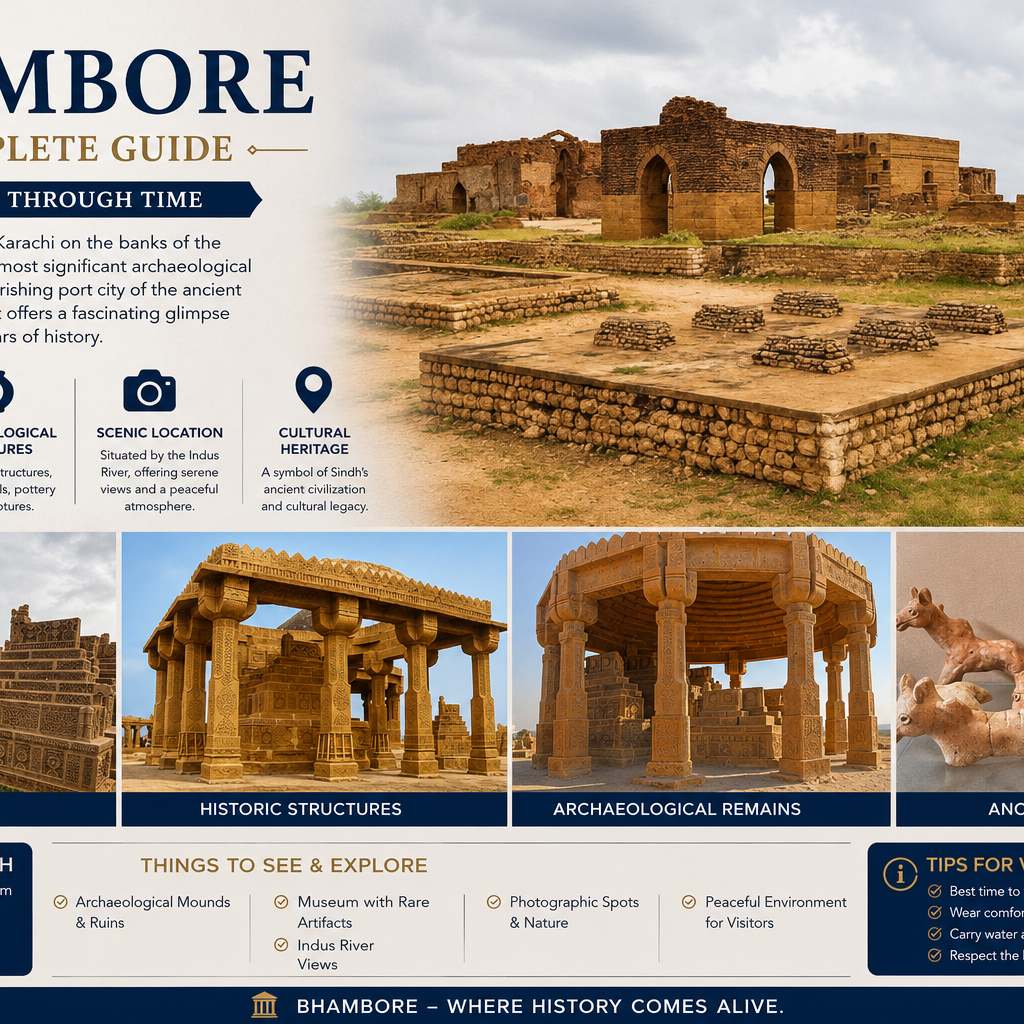
The city was strongly walled. A mud wall and stone fortifications enclosed the settlement. A central stone wall divided it into eastern and western parts. Three gateways led into the citadel. Stone bastions flanked the main gate.
The ruins reveal a working city. Excavators uncovered houses, streets and workshops. A large stone building with a semi circular plan survives too. These remains show a city of trade and industry.
The port structures survive in part. Archaeologists found a half submerged anchorage with stone foundations. Cargo boats probably berthed there. This confirms the role of the site as a port.
Legend of Sassui and Punhun
Folklore places Sassui at Bhambore. Sassui was the daughter of the ruler of the city in the tale. She fell in love with Punhun a prince from Balochistan. His family carried him away. She crossed the desert on foot to find him.
The poet Shah Abdul Latif Bhittai made the tale famous. He wove the romance into his verse. His poetry carries the story across Sindh to this day. The dedicated guide to the poet covers his work in more detail.
The legend draws visitors to the ruins. Many come for the romance rather than the archaeology. Locals long knew the mound as the hill of Sassui.
Excavations and the museum of Bhambore
Excavation began in the twentieth century. Early scholars visited the mound in 1928 and 1929. Further work followed in 1951. F. A. Khan led a major campaign from 1958 to 1965.
Much of the site remains unexcavated. Archaeologists have uncovered only a fraction of the city. The earlier layers lie waterlogged beneath the surface. This means Bhambore still holds many secrets.
The museum displays the finds. A small museum occupies the site. It holds pottery, coins, ornaments and inscriptions. Guides there can explain the layout of the ruins.
Visiting Bhambore
The site lies east of Karachi. Bhambore is around sixty five kilometres from the city. The N 5 highway passes close by. The site lies between Dhabeji and Gharo. The drive takes about one and a half hours.
Combine it with Thatta. Many visitors pair Bhambore with the heritage of Thatta. Makli Necropolis and the Shah Jahan Mosque lie farther along the same road. Each has its own dedicated guide. The combination makes a full and rewarding day.
Come prepared for an open site. The ruins lie exposed with little shade. Wear sturdy shoes and carry water. The cooler months from November to February are the best time.
Frequently asked questions
Where is Bhambore located? Bhambore is located in the Thatta district of Sindh. It lies on the north bank of Gharo Creek. Karachi is around sixty five kilometres to the west. The N 5 highway passes close by. The site lies between Dhabeji and Gharo. The drive from Karachi takes about one and a half hours. This makes it one of the easiest archaeological day trips from the city.
How old is Bhambore? Bhambore was occupied from the 1st century BCE to the 13th century CE. That covers more than a thousand years. Archaeologists have identified three distinct periods at the site. The Scytho Parthian era came first. A Hindu Buddhist period followed. An early Islamic period closed the story. The city was gradually deserted after the 13th century as the Indus shifted course.
Is Bhambore the ancient port of Debal? Many scholars identify Bhambore with Debal. That port fell to the Arab general Muhammad bin Qasim in 711 or 712 CE. Excavations in the twentieth century supported this view. The identification is not universally accepted. Other scholars have proposed different locations for Debal. Some link the site to an even earlier port named in classical sources. The question remains open.
What is the mosque at Bhambore? The mosque at Bhambore carries an inscription dated 727 CE. Excavators discovered it in 1960. That date falls around fifteen years after the conquest of Sindh. This makes it one of the earliest and best preserved early mosques in South Asia. It lies in the eastern part of the walled city. It is among the most significant finds at the site.
Why is Bhambore linked to Sassui and Punhun? Folklore places Sassui at Bhambore. She was the daughter of the ruler of the city in the tale. She fell in love with Punhun a prince from Balochistan. His family carried him away. She crossed the desert on foot to find him. The poet Shah Abdul Latif Bhittai wove the romance into his verse. Locals long knew the mound as the hill of Sassui.
Port that time forgot
Bhambore is one of the great archaeological treasures of Sindh. It holds a walled port city that traded for over a thousand years. Three civilisations left their mark on the same ground. The site holds one of the earliest mosques in South Asia. Its ruined walls, gateways and anchorage recall a city of trade and industry. The Indus shifted course and the creek silted up. The port was then abandoned to the sand.
You may come to Bhambore for its archaeology, its ancient mosque or the legend of Sassui. This ancient port rewards the visit either way. You can walk the walls of the old citadel. You can look at the mosque that has survived thirteen centuries. You can see the finds gathered in the small museum. Karachi lies close by, so the trip is easy. Visit in winter and stand in a city that the river left behind.