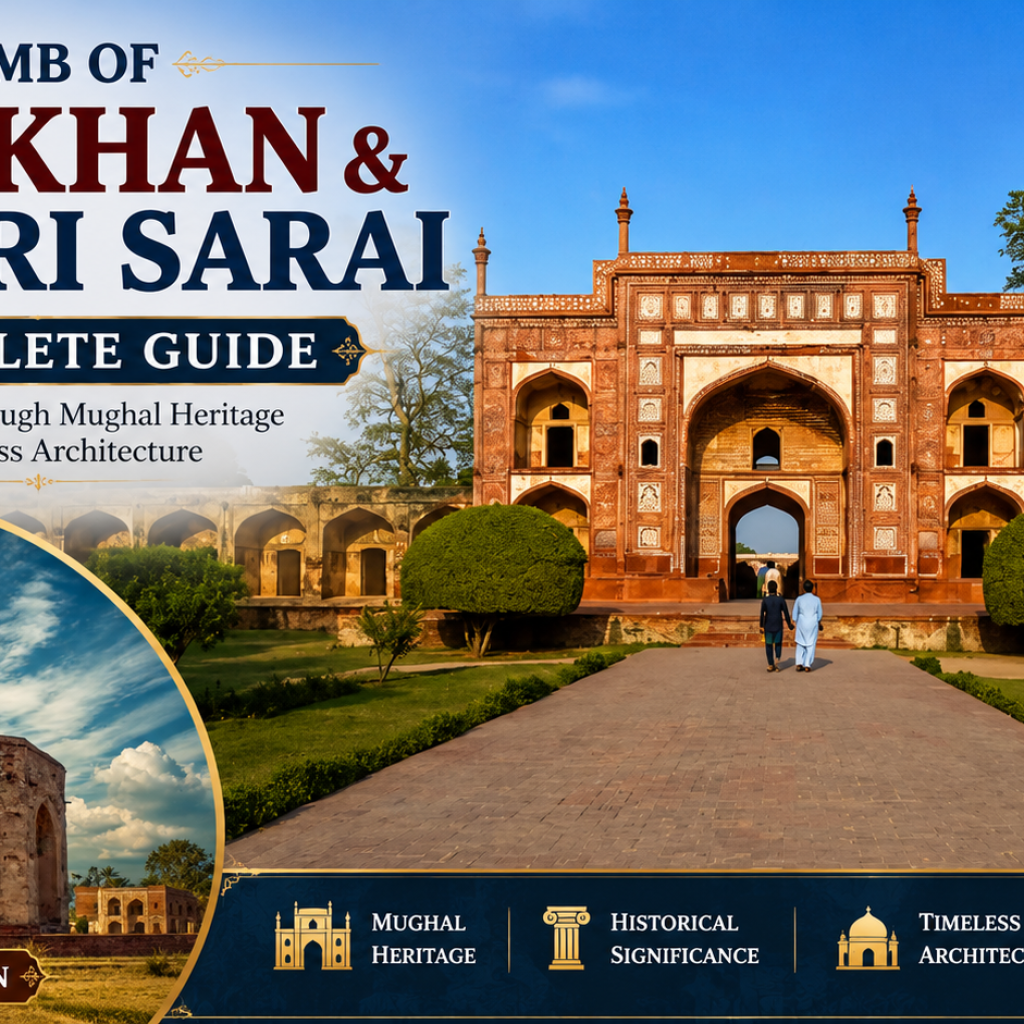
Tomb of Asif Khan and Akbari Sarai: A Complete Guide
Two Mughal jewels rise in old Lahore: the Tomb of Asif Khan and the Akbari Sarai. They rise in the historic necropolis of Shahdara Bagh across the Ravi. They honour a great Mughal noble and serve the grand tomb of an emperor. They blend Persian, Central Asian and Mughal styles in brick, marble and tile. They form part of a great ensemble beside the tomb of Jahangir. This guide covers both monuments for the curious traveller. It explains the history the architecture the ensemble the present state and how to visit.
This guide offers a general overview. Figures and dates vary between sources.
Quick answer: The Tomb of Asif Khan and the Akbari Sarai are Mughal monuments in Shahdara Bagh across the Ravi from Lahore. Emperor Shah Jahan built the tomb between 1641 and 1645 for his brother in law Asif Khan an octagonal brick mausoleum with a bulbous dome. Its companion the Akbari Sarai, built in 1637, is a great caravanserai serving the tomb of Jahangir. Both form part of the Shahdara ensemble with the tombs of Jahangir and Nur Jahan. They are on the tentative list of UNESCO World Heritage Sites. Winter is the best time to visit.
About the monuments
Two historic Mughal monuments rise together in Lahore. They are located in Shahdara Bagh, north of the Ravi. They rise a short way from the great city. They form part of a grand Mughal necropolis.
A Mughal precinct holds them. Shahdara Bagh gathers several great monuments. Tombs and a caravanserai rise together here. This precinct honours the Mughal dead.
They lie on a single axis. A tomb of Jahangir rises to the east. An Akbari Sarai rests between the two tombs. A Tomb of Asif Khan rises to the west.
They share a serene setting. Persian style gardens frame the monuments. A Ravi channel flows nearby to the south. This calm suits a place of the dead.
Asif Khan and his time
Asif Khan was a great Mughal noble. He rose to the highest ranks of the court. He served as grand vizier and commander. He was also a governor of Lahore.
His family shaped the empire. His sister was the empress Nur Jahan. His daughter was Mumtaz Mahal. She became the beloved wife of Shah Jahan.
His daughter inspired a wonder. Shah Jahan built the Taj Mahal for her. This makes Asif Khan the grandfather in law of that wonder. His family stood at the heart of Mughal power.
His life ended in battle. He died in 1641 fighting a rebel chief. Shah Jahan then ordered his tomb. It rose close to the tomb of Jahangir.
Tomb of Asif Khan
This tomb is an octagonal mausoleum. An eight sided plan was reserved for great nobles. Brick forms the whole structure. It rises on a raised podium.
A great dome crowns the tomb. A bulbous white dome rose above the building. It once gleamed across the gardens. This dome is the signature of the tomb.
Rich decoration once clad it. Marble and sandstone carving covered the exterior. Blue Kashi tiles adorned the walls. Traces of this artistry survive today.
A marble cenotaph rests within. White marble forms the cenotaph of Asif Khan. Quranic verses are engraved on it. Its walls carry the ninety nine names of God.
Akbari Sarai
Akbari Sarai is a great caravanserai. It was built in 1637 for travellers and caretakers. It served the keepers of the tomb of Jahangir. It is the best preserved sarai in the country.
Its plan is grand. Arched cells ring a vast courtyard. Grand gateways pierce the walls. Attendants and pilgrims once filled the grounds.
Its gates are notable. A northern gate rises in two storeys. A central arched portal marks it. Kashi tile work once adorned its front.
It links the tombs. A western gate leads to the tomb of Jahangir. An eastern gate faces the tomb of Asif Khan. A small mosque rises in the west wall.
Wider ensemble and present state
This Shahdara ensemble is remarkable. It gathers three great Mughal monuments. Tombs of Jahangir and Asif Khan flank the sarai. A tomb of Nur Jahan rises close by.
A tomb of Jahangir is the jewel. Its interior glows with fresco and pietra dura. It is famed across the world. Its own dedicated guide covers it in detail.
These monuments suffered over time. Sikh rulers plundered the marble and stone. Later neglect wore the buildings down. Encroachment has crowded the old grounds.
Conservation now protects them. A Walled City of Lahore Authority leads the work. Restoration has stabilised the decaying walls. This care aims to save the ensemble.
Visiting the monuments
Come in winter. Lahore is very hot in summer. Winter months from November to February are the finest season. Weather is mild and pleasant then.
Reach them in Shahdara. Both monuments rise north of the Ravi. They are a short drive from central Lahore. A visit combines well with the tomb of Jahangir.
See both monuments together. An Akbari Sarai links the two great tombs. Its gateways and cells are striking. A tomb of Asif Khan rises beyond it.
Allow a couple of hours. This ensemble spreads over a wide area. Sturdy shoes help on the old ground. A guide brings the Mughal history to life.
Frequently asked questions
Who was Asif Khan? Asif Khan was a powerful Mughal nobleman who rose to the highest ranks of the imperial court, serving as grand vizier and commander in chief and later as governor of Lahore. He belonged to the very heart of the Mughal dynasty. His sister was the empress Nur Jahan, wife of Emperor Jahangir. His daughter was Mumtaz Mahal the beloved wife of Shah Jahan, for whom the Taj Mahal was built. Asif Khan died in 1641 while fighting a rebel chief. Shah Jahan commissioned his tomb soon after.
When was the Tomb of Asif Khan built? Emperor Shah Jahan built the Tomb of Asif Khan between 1641 and 1645, following the death of his brother in law. According to the court chronicle the construction took four years and cost over a quarter of a million rupees a significant sum at the time. It was raised in Shahdara Bagh, deliberately close to the tomb of Emperor Jahangir. It is an octagonal brick structure on a raised podium a plan traditionally reserved for high ranking noblemen rather than emperors.
What is the Akbari Sarai? A large Mughal caravanserai the Akbari Sarai was built in 1637, set between the tombs of Jahangir and Asif Khan in Shahdara Bagh. It was originally built to accommodate travellers, pilgrims and the caretakers of the tomb of Jahangir. It consists of many arched cells ringing a vast courtyard, with grand gateways on its sides and a small mosque in the western wall. It is regarded as the best preserved caravanserai of its kind in the country and forms a crucial link within the Shahdara ensemble.
What does the Tomb of Asif Khan look like? Built entirely of brick and raised on a podium the Tomb of Asif Khan is an octagonal mausoleum crowned by a bulbous dome once clad in white marble. Its exterior was originally adorned with carved marble and sandstone, stucco tracery and blue Kashi tiles, of which only traces survive. Inside rests a white marble cenotaph, engraved with Quranic verses and the ninety nine names of God. Much of its rich decoration was plundered under Sikh rule, leaving the tomb in a dilapidated but still striking state.
When is the best time to visit the Tomb of Asif Khan? Winter, from November to February, is the best time to visit the Tomb of Asif Khan and the Akbari Sarai, when the weather in Lahore is mild and pleasant. Summers here are very hot. Both monuments rise in Shahdara Bagh across the Ravi and a short drive from central Lahore. A visit combines naturally with the nearby tomb of Jahangir. Visitors should allow a couple of hours to explore the whole ensemble, wearing sturdy shoes for the old ground.
Mughal necropolis of Shahdara
Two jewels of Mughal Shahdara rise across the Ravi: the Tomb of Asif Khan and the Akbari Sarai. They rose in the great age of the emperors across the Ravi. They honour a noble whose family shaped the empire. They blend brick, marble and tile in a Persian garden setting. They stand within a grand ensemble beside the tomb of Jahangir. Few precincts hold such Mughal grandeur.
You may come for the tomb the sarai or the wider ensemble. This precinct rewards the visit either way. You can admire the octagonal tomb of the great Mughal noble. You can wander the arched cells of the Akbari Sarai. You can pass on to the glowing tomb of Jahangir nearby. Come in winter and explore the necropolis of Shahdara. These are the Mughal jewels across the Ravi.


